maandag 9 maart 2015

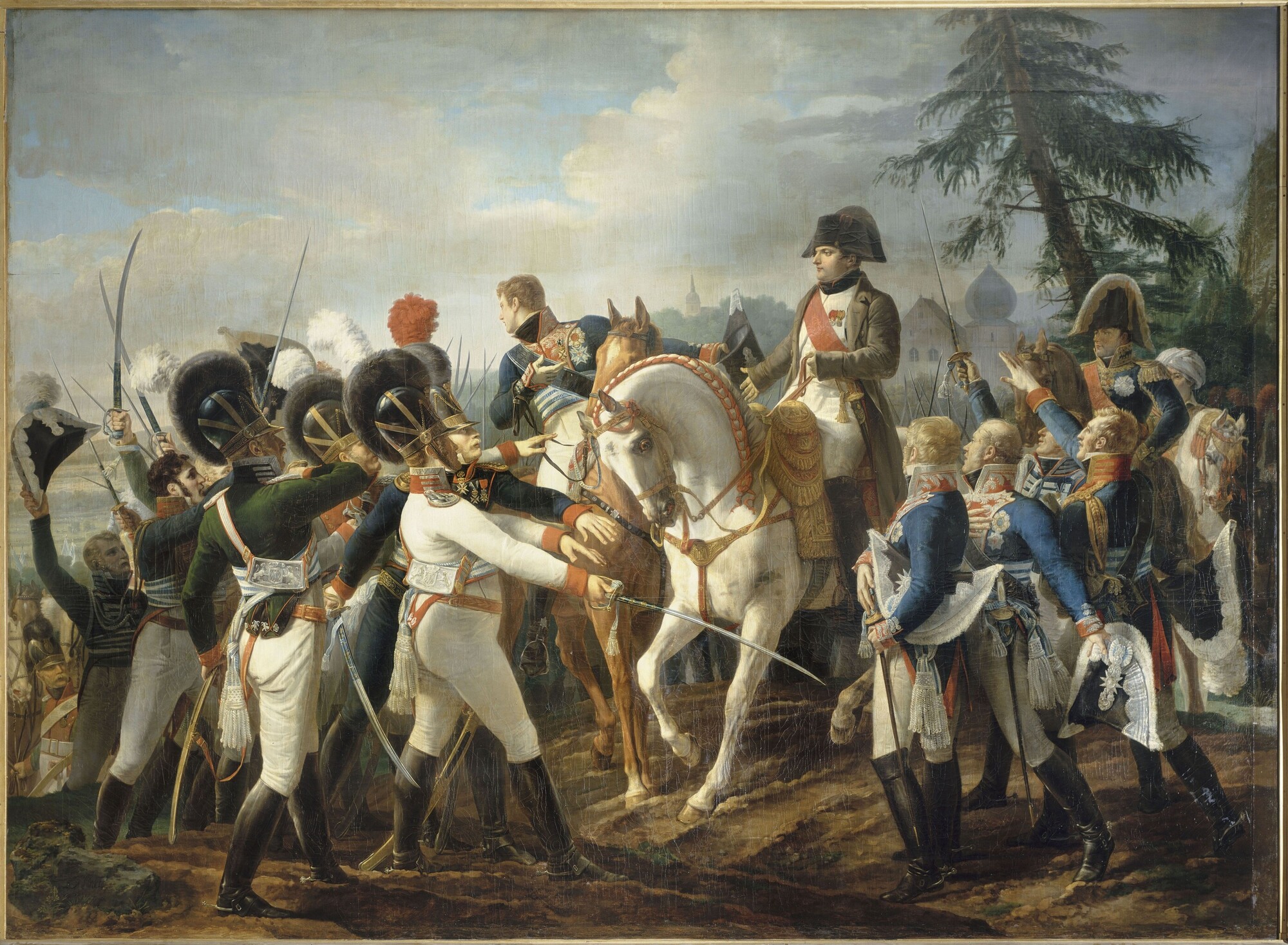
Slag bij Abensberg (20 april 1809)


Napoleon spreekt Beierse troepen toe.
(Jean-Baptiste Debret. Bron: http://upload.wikimedia.org/wikipedia/commons/7/76/Abensberg.jpg)

De Oostenrijkse aanval in Beieren op de Fransen op 9 april 1809 kwam als een verrassing en pas na Napoleon's aankomst aan het front op 17 april werd de orde in de Franse gelederen hersteld.
Napoleon stelde Lannes aan het hoofd van een haastig gevormd legerkorps van 25.000 man dat centraal in de linie stond, met Davout's III Corps op de linker- en Lefebvre's VII Corps op de rechterflank. Napoleon voerde ten zuiden van Abensberg een massale aanval uit op het langgerekte centrum van Aartshertog Karel. Deze aanval splitte het Oostenrijkse leger in tweeën. Karel trok zijn rechterflank terug op Eckmühl, terwijl zijn linkerflank onder generaal Hiller naar het zuiden ging in de richting van Landshut.
 
Door deze aanval slaagden de Fransen er in het initiatief in de Campagne van 1809 te herwinnen. Het Franse leger was numeriek in de minderheid, 113.000 tegenover 161.000 Oostenrijkers, maar wist toch 2.700 Oostenrijkse slachtoffers en 4.000 krijgsgevangenen te maken.
 
(Bron: http://www.westpoint.edu/history/SiteAssets/SitePages/Napoleonic%20War/NapWars97.jpg)
 
Dit artikel maakt onderdeel uit van het project "De vertaling van Dictionary of Napoleonic Wars" en is een vrije vertaling.
Originele tekst: Dictionary of Napoleonic Wars, p. 1.

zondag 8 maart 2015

Slag bij New Orleans (8 januari 1815)

De Amerikaanse generaal Andrew Jackson op de geïmproviseerde verdedigingswerken.
(Edward Percy Moran, 1910. Bron: http://upload.wikimedia.org/wikipedia/commons/3/35/Battle_of_New_Orleans.jpg)

Midden december 1814 landden er 7.500 Britse soldaten onder Sir Edward Pakenham in een baai ten oosten van New Orleans (V.S.) als meest zuidelijke punt van een offensief dat door de Britten op drie fronten geopend was. De lokale commandant, generaal Andrew Jackson, haastte zich met 5.000 Amerikaanse troepen uit Baton Rouge om deze acute dreiging het hoofd te bieden.
In de nacht van 23 op 24 december vielen de Amerikanen aan en ze wisten zo de opmars van Pakenham op zo'n zeven mijl ten oosten van New Orleans tot staat te brengen. Jackson liet zijn troepenmacht twee mijl naar het westen terugvallen en liet een verdedigingslinie opzetten bij het dorpje Chalmette. De verdedigingswerken werden gevormd door omgehakte bomen en balen katoen en de linie liep van de oever van de Mississippi in het zuiden (rechterflank) naar een moerasgebied in het noorden (linkerflank) over een lengte van ongeveer anderhalve kilometer.
Kaart van het slagveld.
(Bron (grotere afbeelding): http://upload.wikimedia.org/wikipedia/commons/0/00/Battle_of_New_Orleans_1815.jpg)
 Op 8 januari 1815 viel de Britse commandant met 5.300 frontaal de verdedigingslinie van Jackson aan. De aanval werd echter al gauw tot staan gebracht door het Amerikaanse artillerie- en musketvuur. Er werd een tweede poging ondernomen door Pakenham, maar met hetzelfde resultaat en nadat zij in een half uur tijd 2.036 manschappen hadden verloren besloten de Britten zicht terug te trekken, Pakenham was zelf een van de dodelijke slachtoffers. De Amerikanen hadden zelf slechts 8 doden te betreuren en er waren aan hun zijde slechts 13 gewonden. De Vrede van Gent was op 24 december 1814 door de Verenigde Staten en Groot-Brittannië was ondertekend, maar het bericht over dit vredesverdrag bereikte New Orleans pas na de veldslag. De actie bij New Orleans droeg positief bij aan de reputatie van Andrew Jackson, die later president van de Verenigde Staten zou worden.   
 
Andrew Jackson (1767 - 1845)
(Bron: http://thepapersofandrewjackson.utk.edu/)

Sir Edward Pakenham (1778 - 1814)
(Bron: https://symonsez.files.wordpress.com/2010/01/pakenham.gif)
 
Dit artikel maakt onderdeel uit van het project "De vertaling van Dictionary of Napoleonic Wars" en is een vrije vertaling.
Originele tekst: Dictionary of Napoleonic Wars, p. 312.

zaterdag 7 maart 2015

Project: De Vertaling van "Dictionary of the Napoleonic Wars (David G. Chandler, 1979)"

Van mijn makker Onno de Meer van Jomini ontving ik recent het boek Dictionary of the Napoleonic Wars van David G. Chandler. Het boek is uit 1979 en omvat vrijwel alle begrippen, veldslagen en personen die een rol hebben gespeeld in de Napoleontische Oorlogen. Tevens zijn er diverse diagrammen, tijdsbalken, afbeeldingen en kaarten in het boek opgenomen ter illustratieve ondersteuning.
 
Omdat ik mij weer meer met militaire geschiedenis bezig wil houden en ik het leuk vind om meer te weten te komen over het voornoemde conflict, bedacht ik mij dat het misschien wel aardig zou zijn om Dictionary of the Napoleonic Wars naar het Nederlands te vertalen. Door dit te doen sla ik verschillende vliegen in een klap. Ik breid mijn eigen kennis uit, ik houd mijn schrijf- en vertaal vaardigheden op peil, ik ben weer bezig met mijn passie en, last but not least, ik bouw langzaam maar zeker een uitgebreid Nederlandstalig online naslagwerk op over de Napoleontische Oorlogen.
 
Ik zal proberen om zoveel mogelijk afbeeldingen bij de artikelen te voegen en af en toe wat extra informatie te geven. De afbeeldingen uit het boek zijn prima, maar ik ben niet in de gelegenheid deze in te scannen dus we zullen het moeten doen met elders verkregen afbeeldingen. Ik kan ook foto's maken van de afbeeldingen, maar daar verwacht ik kwaliteitstechnisch gezien niet zo veel van.
Ook moeten we niet vergeten dat het boek al bijna 36 jaar oud is en het voor kan komen dat de destijds bekende gegevens inmiddels achterhaald zijn. Wanneer dit het geval is en ik deze extra "externe" informatie aan een artikel toevoeg zal ik dat vermelden.

Ik ben niet van plan om dit project alfabetisch aan te pakken. De ter vertaling uitgekozen begrippen zijn puur gebaseerd op mijn eigen interesse. Ook is het niet waarschijnlijk dat er regelmaat zit in de publicatie van nieuwe vertalingen.
 
David Chandler in zijn werkkamer.
(bron: http://www.napoleonicsociety.com/images/Chandler_office.jpg)
Ik hoop dat jullie net zoveel plezier zullen beleven aan het lezen van de artikelen, als ik beleef aan het schrijven er van.

donderdag 22 november 2012

E-ligther: Powering the mission

Translated from Dutch by JK'87, original source: I. Koomen, 'E-lighter houdt militair op spanning', published in Defensiekrant edition 32 on 25 October 2012. (http://www.defensie.nl/actueel/defensiebladen/defensiekrant/2012/46200051/Defensiekrant_nr_32_2012)


Batterijen
(Source: http://tweakers.net/nieuws/32652/)


The armed forces protect our freedom, security and prosperity in The Netherlands and abroad. To properly and safely fulfil this important task, our people need the right and most modern systems and equipment. That’s why we invest in innovation, so we continue to be able to defend our country, support the civil services and combat terrorists and pirates. The Defensiekrant (Defence newspaper) will in accordance publish a few articles about innovative projects within the armed forces. In this third instalment we analyse the e-lighter as part of the VOSS soldier modernization program.

Improved survivability, better command and control and more freedom of movement and strength; these are the objectives of the Verbeterd Operationeel Soldaat Systeem (VOSS) (Improved Operational Soldier System). This name incorporates the set of innovations intended for the most important weapon within the armed forces: the individual serviceman. Water and food, munitions and dressings and today more important than ever: the batteries. Without these means no soldier ever leaves his base, says Luc de Beer, VOSS project leader of the Defensie Materieel Organisatie (Defence Equipment Organization). “Our soldiers will depend more and more on technology”, he explains. “Radio, GPS, night vision, illumination, directing means and so forth will only further increase the demand for energy.” As a result soldiers have to carry a considerable amount of batteries. Thereby, because each system uses a different type of battery, the variety of batteries they have to take with them is quite extensive. “Al these types of batteries take up a lot of space in the backpack”, explains De Beer. “Space you would rather use for extra food, munitions and dressings.” However, the project leader still emphasizes that batteries are just as essential as munitions. “If your batteries run out, you can practically say the mission is over.” Because without systems like: communication, GPS, night vision and the like, individual soldiers will become less operational and furthermore more vulnerable. 


(Source: http://www.defenceweb.co.za/index.php?option=com_content&view=article&id=19405)

Plain and simple
The e-lighter is designed to prevent soldiers from running out of energy. Soldiers serving in combat units will in future missions be equipped with these compact generators. This smart system, the size of a soda bottle, acts like a universal trickle charger. With it the individual soldier is able to provide all systems with enough energy. It thus eliminates the need to bring a large variety of spare batteries and also easily extends the duration of the mission, whenever necessary. During some combat actions it is just a matter of: ‘who can endure the longest’. The e-lighter provides in these situations the necessary sustainability. The e-lighter runs on ordinary diesel fuel. “This unique concept is developed by Fokker Aerostructures”, Luc de Beer emphasizes. Other portable generators use methanol for example to generate electricity. This means you have to frame a whole new logistics line, just for this one product. The e-lighter on the other hand uses ordinary diesel fuel, which is almost always available even in the most remote and challenging mission areas. The generator is furthermore very robust and reliable and can both be taken inside and attached underneath the backpack. “One liter diesel is enough for the e-lighter to work for 48-hours and provide all of the required energy”, says De Beer. In 2013 infantry, marines and Special Forces will test the prototypes. It is then that this smart device will have to prove itself as an auxiliary engine of the mission.

woensdag 21 november 2012

Scheiding / Schism


Om een duidelijkere richting te geven aan dit blog heb ik besloten om op Stand Your Ground puur te berichten over militaire geschiedenis en algemene militaire zaken. Contemporaine conflicten en gebeurtenissen en profielen zullen voortaan worden gepubliceerd op het blog WorldWideConflicts. De berichten die nu al op Stand Your Ground staan zullen hier ook blijven, zij zijn wel 1 op 1 gekopieerd naar WorldWideConflicts omdat zij op dat blog nog beter tot hun recht zullen komen.
 
Ik hoop dat alle lezers beide blogs zullen blijven volgen! Zo niet, dan hoop ik dat u in ieder geval een van de twee zult blijven volgen.
 
TdH1980

--------------------------------------------------------------------------------------------------------------------------

To give a more clear guidance to this blog, I've decided that from now on Stand Your Ground will be used for publications on military history and general military affairs only. Contemporary conflicts and events and profiles will from now on be published on WorldWideConflicts. The messages on this subjects that are on Stand Your Ground will remain here, but they've been copied to WorldWideConflicts as well.
 
I hope you will follow both my blogs! If not, I hope that you'll continue to read one of them.
 
TdH1980

donderdag 1 november 2012

Waterloo 200

For me personally the Battle of Waterloo (June 18th 1815) and the others battles connected with this big battle (Quatre Bras, Ligny, both June 16th 1815, and Wavre, also June 18th 1815) are special. I can not remember how it happened but for some reason the Battle of Waterloo got my special attention since I was a little kid. Actually, this battle was the main reason I got interested in History and military affairs in the first place. On my first school notebook I glued a picture of the painting "Napoleon crossing the Alps" by Jacques-Louis David. When I started amature wargaming, my Napoleonic figures were my favorites. My first visit to a battlefield, when  was thirteen, was at Waterloo and during my study I wrote my Bachelor thesis on the Battle of Quatre Bras.

So the Battle of Waterloo was a red line through my life and now, in 2015, we have the bi-centenary. I am really looking forward to the commemoration and therefore I am happy that I've discovered the organization Waterloo 200. 


Waterloo 200 Ltd is an umbrella organisation approved and supported by (UK) Government to oversee the celebration of the 200th annivesary of the Battle of Waterloo. It can bestow official status upon organisations that it feels would make a valuable contribution to the celebrations and, indeed, the general good of the countries involved.

This organization and it's website make it possible to follow all the anniversaries organized and celebrations by different other organizations and countries. Furthermore the website gives information about the battle itself, tips for a visit to the battlefield, information about re-enactment and more.

So if you want to join in the commemoration and/or want to be up-to-date about what's going on, this is the place to be. The link to the website is here: http://www.waterloo200.org/ 

For further reading I can recommend The Battle of Waterloo, Also of Ligny and Quatre Bras, etc. printed in 1817 and available in PDF for free. It's a massive collection of 'all' available eyewitness accounts of the battle and affiliated events, letters, notes by officers, lists of casualties and officers that were present and more. It's a really big piece of work, but as complete and contemporary as it can get.


donderdag 4 oktober 2012

Mali: Background of Iyad Ag Ghali, leader of Ansar Dine


Iyad Ag Ghali (source: lignet.com)
Translated from French by TdH, original source: 02/10/2012 at 10: 35 By L. Touchard, B. Ahmed, Ch Ouazani / Jeuneafrique.com (http://www.jeuneafrique.com/Articles/Dossier/JA2698p024-033.xml11/mali-terrorisme-mouammar-kaddafi-mplamali-iyad-ag-ghali-rebelle-dans-l-ame.html)

Iyad Ag Ghali is a 54 years old Malian. He is the leader of Ansar Dine.

From the region of Kidal, northern Mali, Iyad Ag Ghali is a Irayakan, family of the Ifoghas. It is in Libya, however, where he made his debut in the early 1980s: in his early twenties he chose to join the Islamic Legion of Colonel Gaddafi - Mali, a victim of repeated droughts since 1969, has nothing to offer to him.


Islamic Legion

In Libya, Ag Ghali manages to get noticed. He was sent to Lebanon to fight the phalanges and Christians, according to some sources, aside from some shooting in Chad, in the course of the 1980s, before returning to Mali when the "Guide" declares the dissolution of the Legion. Ag Ghali is disappointed, but soon found another cause to champion, becoming one of the leading figures of the Tuareg rebellion: it was he who, at the head of the Popular Movement for the Liberation of Azawad (MPLA), attacked the town of Menaka, June 28, 1990. Six months later, the Tamanrasset agreements were signed under the auspices of Algeria, brought an end to the fighting, but the rebels were deeply divided. Ag Ghali founded the Popular Movement of Azawad (MPA), which brought together the most moderate Tuaregs, he didn’t hesitate to confront his former companions and sometimes to allied with the Malian army... His military superiority isn’t doubted. For many Malians he is the one that brought peace to the North in the late 1990s.

Gradually, the man got in to contact with radical preachers like the Pakistani Jamaat al-Tabligh ("association for preaching"). In  1999 Iyad Ag Ghali has changed: he stopped shaking hands with women, made his wife wear a veil and spends most of his free time in mosques. Surprising? Not so much. This radicalization is associated with a strong anti-Western sentiment, sharpened in training camps in Libya. In addition, the economic crisis has pushed many Malians, both sedentary and nomadic, into the arms of religion.

In 2003, Ag Ghali is involved with the fundamentalist cause, but not Jihadism: he said to be hostile to terrorism and suicide bombings. This "state of mind" makes him the ideal intermediary to negotiate the release of hostages held by Islamic Salafist Group for Preaching and Combat (GSPC). Thus, in August of the same year the government in Bamako asked Ag Ghali to intercede with Abou Zeid for European tourists kidnapped in Algeria - which he did with success. Three years later, in May 2006, the anger is brewing again in Northern Mali. Tuareg accuse the authorities of failing to meet their commitments. Ag Ghali meets with President Amadou Toumani Toure (ATT), but negotiations fall short. He then approaches Ibrahim Ag Bahanga, another great figure from irredentist Tuareg, who died in August 2011. Algeria is again involved, obtains the signature of new agreements for peace (the Algiers Accords, signed in July 2006) and, as in the previous uprising, Ag Ghali traded his fighting uniform for a uniform of a man of peace.

Ahmada Ag Bibi: the bosun

Ahmada Ag Bibi and Iyad Ag Ghali know each other for a long time. In the early 1990s already, they both were in the People's Movement of Azawad (MPA). Ag Bibi is a great activist for the Tuareg cause, but that does not stop to soak in more obscure cases and to be linked to negotiations for the release of Western hostages. In Ag Bibi’s address book there are bandits, smugglers, politicians in Bamako and Algiers, and even members of several intelligence services (he was a member of the parliamentary committee Defense and Homeland Security). Also he was the chairman of the parliamentary group for Mali-Algeria friendship and in November 2011 he accompanied  the former colonel in the French army, Jean-Marc Gadoullet, to negotiate for the release of Abu Zayd AREVA and VINCI hostages.
    When the North rised again in January 2012, Ag Bibi joined the MNLA and Ansar Dine, driven by both realism and friendship towards Ag Ghali. He is not attached to secularism, but believes, as the Ansar Dine diplomat Alghabass Ag Intallah, in negotiating "peaceful solutions" and could therefore be the man to talk to. "Only Algeria can play a role of mediator between the parties to the conflict," he said.

To serve his ambitions, he will not hesitate to turn against his "partners”.

Exile

ATT, who knew Ag Ghali could be useful but also feared his growing influence, appointed him counsel consular in Jeddah (Saudi Arabia) in November 2007. The head of state is as much to thank for cutting him from his supporters. But exile was short-lived: in 2010, the Saudis suspected Al Ghali of being in contact with members of Al-Qaeda and expelled him. Back home, he used again his address book (which was further enriched during the episode in Jeddah) to negotiate hostage releases and build a personal fortune. His name comes up repeatedly when discussing the fate of AREVA employees kidnapped in Niger in September 2010.

By the end of 2011, the National Movement for the Liberation of Azawad (MNLA) didn’t have an official status yet, but Ag Ghali already boasted to be the leader. In vain. Managers of the future rebellion didn’t want to see this shady man get into the political and media area. He is too closely linked to Al-Qaeda in the Islamic Maghreb (AQIM, formerly GSPC) and suspected of being linked to Algiers as well. Also they have not forgiven him the 1990’s infighting either.

Ag Mohamed Najim, another veteran of the Islamic Legion who Ag Ghali cordially detests, is therefore preferred. This is a slap for Ag Ghali but he didn’t mind. He created his own training group, Ansar Dine. Probably he hoped to cause dislocation of MNLA, which weaknesses he knows so well the. At the same time, Ag Ghali also renounced to become the successor of the amenokal (traditional leader) of Ifoghas, the old Intallah Ag Attaher preffered his son, Alghabass Intallah Ag. Again, the bitterness is strong, but he cannot afford to openly confront the patriarch.

It is better to deal and work hand in hand with Ag Intallah, who is highly respected in the region. Ag Ghali holds his hand in June 2012. The MNLA is dying, and now it is Ansar Dine which discuss with the mediator of the Economic Community of West Africa (ECOWAS), President Blaise Compaoré of Burkina Faso. The former soldier of Gaddafi is now recognized as a key player in the Malian crisis. If he distanced himself from the Salafists, as incited by foreign diplomats, he might even become an ally. Moreover, if he considers that direct confrontation with AQIM can serve his ambitions, he will not hesitate to turn against its current "partners". Abou Zeid, Mokhtar Ould Mohamed Hamada and Belmokhtar Kheirou know better than anyone else.

Alghabass Ag Intallah: heir and diplomat

Originally Alghabass Ag Intallah isn’t  a warlord. As a member of the National Assembly, he is especially the son of the powerful Ifoghas chief and his designated successor - a line that allows him to benefit from many contacts into the Persian Gulf, including the royal family of Qatar. When the Tuareg rebellion broke out in January 2012, he first ranked alongside the National Movement for the Liberation of Azawad (MNLA) - though always advocated for dialogue with Bamako - then rallied Ansar Dine. Ag Intallah is not a fanatic, and his choice is probably more pragmatic - the fragmentation of MNLA is unequivocal - ideologically. Today, Ag Intallah is the political face of Ansar Dine, it’s ambassador. He is the one who is received by the mediator of the crisis, the Burkinabe President Blaise Compaore. Iyad Ag Ghali knows too much for having interest in linking his fate to reign Ifoghas.

A video in which Ag Ghali leads the prayer before the Aguelhok Massacre (WARNING: GRAPHIC CONTENT)